The Complete Fireworks Glossary: Every Pyrotechnic Term Explained (2026)
Spend five minutes in the world of fireworks and you’ll realize it has a vocabulary as rich and precise as any craft — a shorthand built over centuries that lets a buyer, a display technician, or a fan describe a burst down to its shape, color, and even its sound. Yet for the casual spectator or first-time buyer, that shorthand can feel like a wall. Words like crossette, kamuro, lift charge, and 1.4G fly past with no easy anchor. That’s exactly what this page is for.
This complete fireworks glossary collects the terms that matter most — from the gear that launches a shell to the chemistry that paints it red, green, or blue — and defines each one in plain, practical language. Whether you’re shopping for your next backyard show, decoding a professional cue sheet, or simply want to know the difference between a peony and a chrysanthemum, you’ll leave here able to read every burst like a pro.
What Is a Fireworks Glossary (and Why You Need One)
Fireworks have a language all their own. Walk into any fireworks stand, browse an online retailer, or read a show cue sheet and you’ll quickly run into terms that sound more like a foreign tongue than English: brocade crown, crossette, palm, willow, dragon’s eggs, lift charge, mortar tube, cake. To newcomers it can feel impenetrable; to veterans it’s a precise shorthand that says exactly what a piece will do the moment it leaves the tube.
This fireworks glossary is designed to bridge that gap. Whether you’re buying your first assortment for the backyard, reading a professional display spec sheet, or simply want to understand the commentary at your town’s Fourth of July show, the terms below will help you read every burst like a pro. Think of it as the companion to our complete guide to types of fireworks — that article tells you what each category is; this one defines the words you’ll encounter when shopping, shooting, and spectating.
Below you’ll find the most important pyrotechnic terms, organized from the basics every consumer should know through the effects language that makes fireworks so endlessly watchable.
Equipment & Construction Terms
Shell — The spherical (or cylindrical) container that holds the stars, bursting charge, and other effects. Aerial shells are launched from a mortar tube and break high in the air, producing the familiar “flower” of color. Shell diameter (measured in inches) is the single biggest predictor of burst size and altitude.
Mortar tube — The launch tube that fires a shell or artillery shell into the air. For consumer fireworks, these are often thick cardboard or HDPE (high-density polyethylene) tubes. The “1.4G” consumer shells must be used only with the tubes supplied or recommended by the manufacturer.
Lift charge — The small, fast-burning charge at the base of a shell or rocket that propels it skyward. It’s what turns a ground-level object into an aerial effect.
Stars — The individual pellets of pyrotechnic composition that burn with a specific color and effect when the shell breaks. The pattern in which stars are packed inside the shell determines the shape the burst takes.
Cake — A consumer firework consisting of multiple tubes fused together to fire a series of aerial shots in sequence, each with a short delay. The number right before “g” (as in “200g cake” or “500g cake”) refers to the total weight of pyrotechnic composition permitted. See our dedicated 200g vs 500g cakes buyer’s guide for the full comparison.
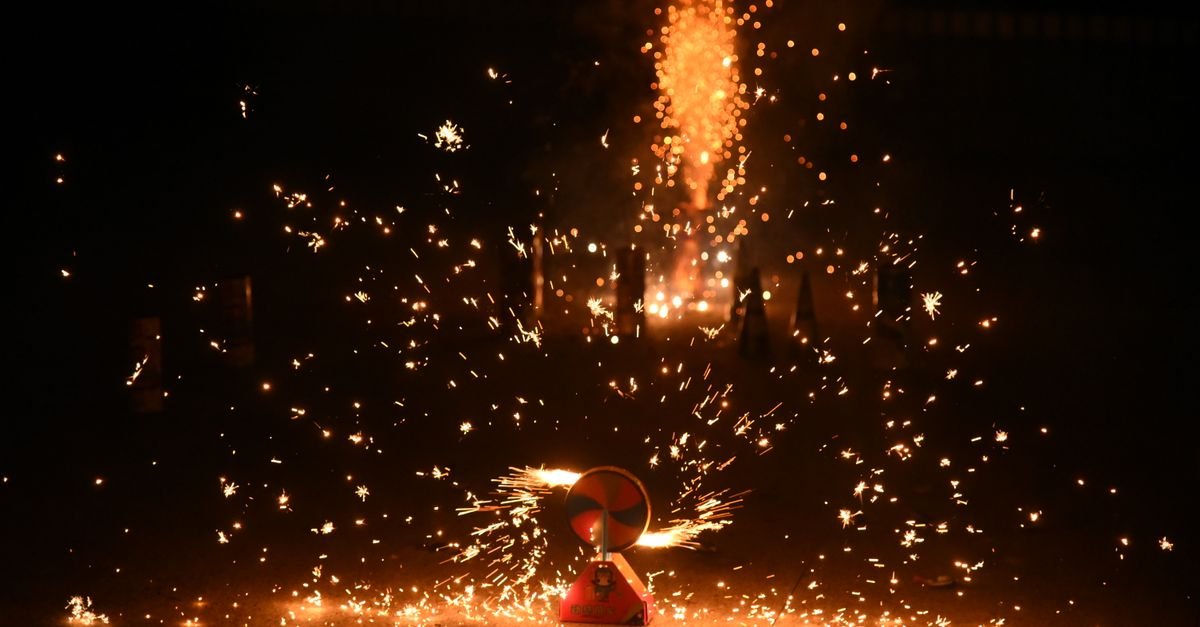
Fountain — A ground-based firework that emits a shower of sparks and colored flame from a tube, typically for 30 seconds to two minutes. Fountains are among the safest and most popular family fireworks.
Roman candle — A tube that ejects a series of stars, shells, or effects one at a time from the top, with a delay between each shot.
Mine — A ground effect (also “mine” charge) that instantly throws a plume of stars or sparks upward from a single tube without a rising projectile.
Sparkler — A handheld wire or stick coated in a slow-burning composition that throws off bright, crackling sparks. Note that sparklers burn hot — well over 1,000°F — and deserve the same respect as any other firework, a point we emphasize in our fireworks safety tips guide.
Effects & Burst Shapes
Peony — The most common and instantly recognizable shell effect: a spherical break of colored stars that trail outward evenly in all directions, then fade. The default “fireworks flower.”
Chrysanthemum — Like a peony, but each star leaves a visible trail or “tail” as it flies outward, creating a layered, multi-dimensional look. The most popular professional effect.
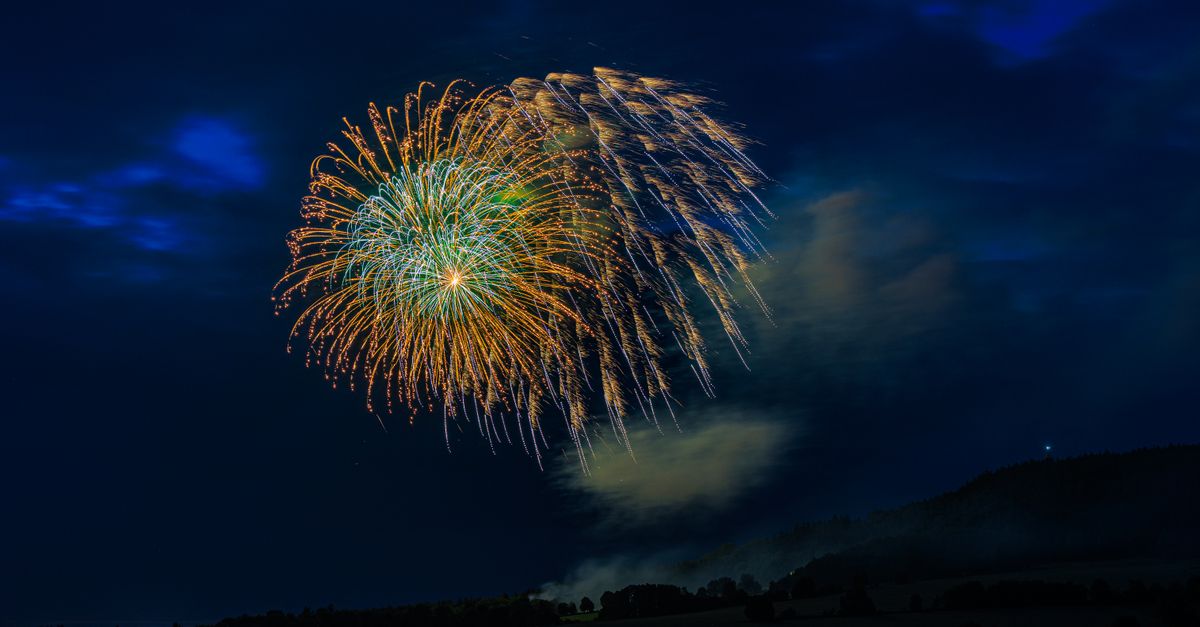
Willow — Long-burning stars (often gold) that droop gracefully downward as they fade, resembling the hanging branches of a willow tree. Slow, elegant, and long-lasting.
Palm — A burst that creates a tall central trunk of ascending sparks with drooping branches that fall like a palm frond, often in gold or silver.
Crossette — A shell whose stars split into four (or more) smaller segments mid-flight, producing a “crisscross” pattern that resembles a lattice or a grid of small comets.
Ring — Stars packed in a precise circle that expands outward as a perfectly round ring or “halo” rather than a full sphere.
Spider — A shell charged with a fast, staccato crackling effect (see “crackle” below) that leaves a web of thin, twinkling trails that linger in the sky.
Kamuro — A delicate Japanese effect made of fine, exceptionally long-burning gold stars that fall slowly, creating a soft curtain of glittering golden threads.
Fish / Dragon Eggs — “Fish” are fast, darting comets that streak erratically in random directions. “Dragon eggs” are small pellets that explode into a bright, sputtering crackle of tiny pops — the noisy, sparkly finishing touch on many cakes and shells.
Crackle — The rapid-fire “snap-crackle-pop” effect made by specialized pellets (often lead-free dragon eggs) that burst in quick succession. It supplies the frantic finale energy to countless consumer cakes. This is closely tied to the science behind the sounds fireworks make.
Salute — A shell (or part of a shell) designed almost purely for its loud report — the deep, percussive “boom” — using flash powder. Salutes deliver shock and thunder to punctuate a display.
Strobe — A star that flashes on and off rapidly, creating a blinking or shimmering effect rather than a steady burn.
Hummer / Whistle — Devices that spin or burn in a way that produces a humming or high-pitched whistling sound. The whistle comes from a specialized composition of potassium benzoate that oscillates as it burns — the same principle explained in our article on how fireworks make their sound.
Color & Chemistry Terms
Metal salts — The chemical compounds that give fireworks their color. Each element burns with a signature wavelength: strontium compounds produce red, barium produces green, copper produces blue, sodium produces yellow, calcium produces orange, and aluminum, titanium, and magnesium produce white and silver sparks. For the full chemistry, see our guide to the science behind fireworks colors.
Flash powder — An extremely fast-burning mixture (traditionally potassium perchlorate and aluminum) used for reports and lifting charges. Its violent, near-instantaneous burn is what produces the loud “boom.”
Black powder — The original pyrotechnic, a mix of potassium nitrate, charcoal, and sulfur. Still the workhorse for lift charges and fuses and the historic foundation of the entire craft traced in our article on how fireworks are made.
Classifications & Regulatory Terms
1.4G vs 1.3G — United Nations/DOT hazard classifications. “1.4G” covers consumer fireworks — the types legal (in most states) for ordinary people to buy and use. “1.3G” covers professional display fireworks, which require a federal ATF explosives license and permits. For a full deep-dive, see our guide to what 1.4G consumer fireworks are.
CE / DOT certified — Certification marks indicating a firework has been tested and approved to meet the safety standards of the European (CE) or United States (DOT/CPSC) markets. Reputable manufacturers such as Skysong Fireworks — based in Liuyang, China, and operating since 2005 with both CE and DOT certifications — build compliance directly into their production and quality-control processes to serve buyers across 30+ countries.
EX number — A U.S. Department of Transportation “EX approval” number assigned to a specific firework after it passes testing, confirming the device is acceptable for transport and entry into commerce.
ATF license — A federal explosives license issued by the Bureau of Alcohol, Tobacco, Firearms and Explosives, required to manufacture, import, or use professional (1.3G) display fireworks.
How to Read a Fireworks Label or Cue Sheet
Now that you know the vocabulary, the labels on a consumer product and the cue sheets used by display technicians start to make sense. A typical consumer cake label will list its effect type (“peony,” “willow,” “crossette”), shot count (the number of tubes), and a weight class (200g or 500g). A professional display cue sheet, by contrast, might read something like “3-inch gold willow shell, 4-inch red peony, 5-inch chrysanthemum with crackle finale” — which now translates cleanly: a mid-size gold willow, followed by a red peony, capped with a larger chrysanthemum that finishes in a burst of crackle.
Learning to parse these descriptions is the fastest way to shop smarter. Once you can read “willow” and “crossette” and “dragon eggs” off a label, you’re no longer buying blind — you’re curating a show. Pair this glossary with our guide to the top 10 fireworks effects to understand exactly which effects belong together in a well-paced sequence.
From Vocabulary to Confidence
Fireworks jargon exists because the craft is precise — and because the people who love it want to talk about it with accuracy. Whether you hear “that was a gorgeous kamuro” at a professional show or peel back the wrapper on your first 500g cake, the terms above give you the fluency to understand, compare, and — most importantly — enjoy the night sky on its own terms. As you go deeper, remember that every one of these effects traces back to the same fundamentals of chemistry, physics, and careful construction, which we explore step by step in our guide to how fireworks are made.