
The Science Behind Fireworks Colors: How Pyrotechnic Chemistry Creates the Night Sky’s Palette
# The Science Behind Fireworks Colors: How Pyrotechnic Chemistry Creates the Night Sky’s Palette
## Introduction
Every summer evening, when the sky erupts into brilliant reds, greens, blues, and golds, few spectators stop to wonder: *how do fireworks makers produce such vivid colors?* The answer lies not in magic but in chemistry — a careful blend of metal salts, oxidizers, and heat control that turns a simple explosive shell into a canvas of light.
Understanding **how fireworks produce color** reveals just how precise and sophisticated modern pyrotechnics have become. From the deep crimson of a strobe mine to the electric blue of a titanium salute, each hue is the result of specific chemical reactions engineered at the molecular level.
## The Chemistry of Color: How It Works
Fireworks get their color from **metal salts** — compounds that contain specific metal elements. When heated to extremely high temperatures (typically 1,700–2,000°C or 3,000–3,600°F), these metals absorb energy and become “excited.” As they cool, they release that energy in the form of visible light. The wavelength (and therefore the color) depends entirely on which metal is used.
This process is called **atomic emission spectroscopy**, and it’s the same principle that gives neon signs their glow.
Here’s a breakdown of which metals create which colors:
– **Red:** Strontium salts (strontium nitrate, strontium carbonate)
– **Green:** Barium salts (barium nitrate, barium chlorate)
– **Blue:** Copper compounds (copper chloride is the most reliable)
– **Yellow:** Sodium salts (sodium nitrate, cryolite)
– **Orange:** A blend of strontium (red) and sodium (yellow)
– **Purple:** A blend of strontium (red) and copper (blue)
– **Gold:** Iron filings, charcoal dust, or magnesium
– **Silver/White:** Magnesium, aluminum, or titanium powder
– **Teal:** Copper + barium combination
Each color family presents its own manufacturing challenges. Blue, for instance, is notoriously difficult to stabilize because copper compounds break down at high temperatures. This is why high-quality blue fireworks are a hallmark of experienced manufacturers.
## Beyond Simple Colors: Creating Effects
While color is the most visible feature, modern pyrotechnics layer multiple effects to create the stunning displays we see today:
### Strobe Effects
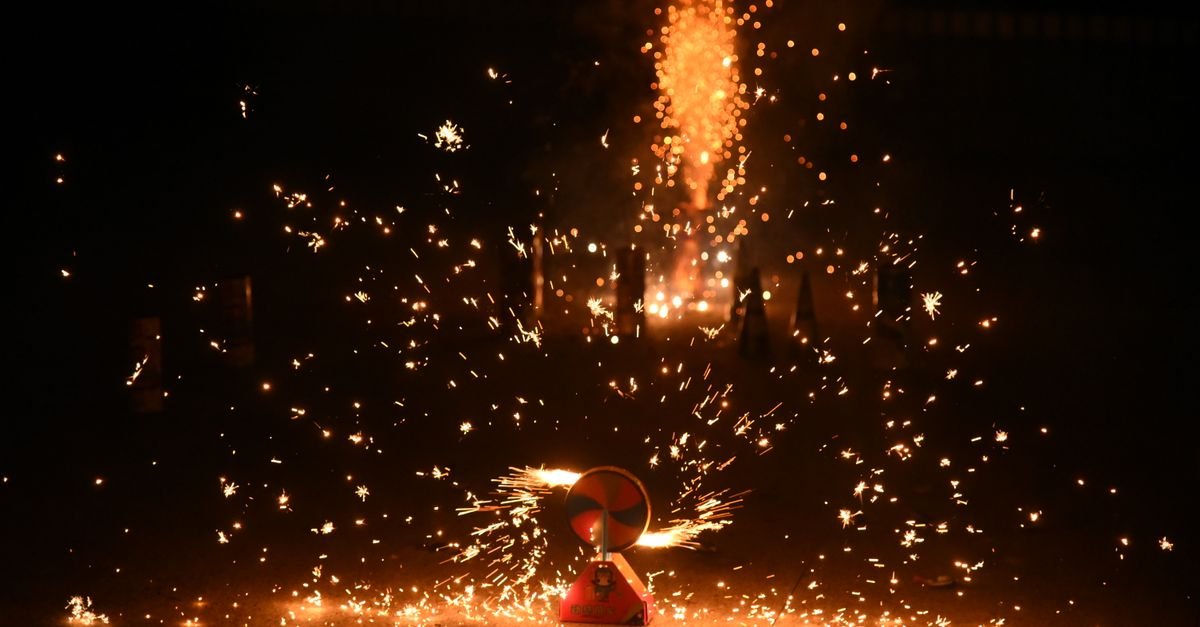
Strobe fireworks use carefully balanced fuel mixtures that alternate between burning and cooling rapidly, creating a flashing effect. Magnesium-based strobe compositions produce bright white flashes, while adding metal salts creates colored strobes.
### Crackle and Whistle
Tiny granules of lead oxide or bismuth compounds create the familiar crackling sound. When these granules ignite, they expand and fracture with tiny explosions. Whistle effects, on the other hand, use a tube packed with a slow-burning composition — the escaping gas creates a whistling tone similar to a teakettle.
### Titanium Salutes (Flitter Effects)
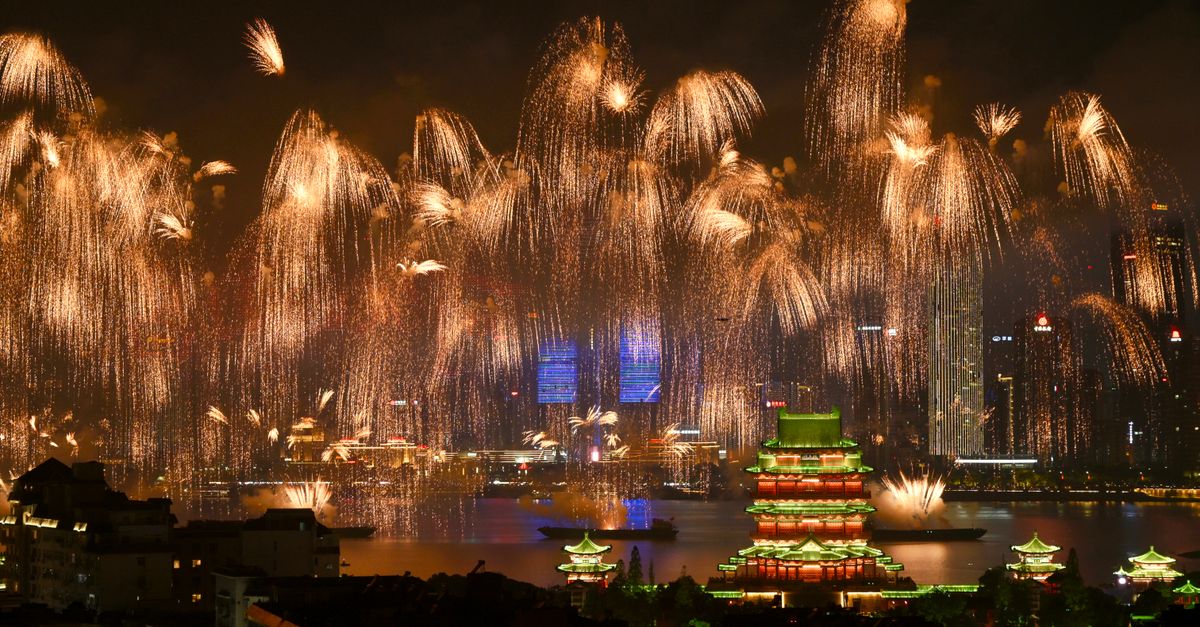
Titanium flakes or spongy titanium pieces burn at extremely high temperatures, creating brilliant white sparks that shower outward. These are the “brocade” or “pistil” effects that look like willow branches or palm trees of light.
### Color-Changing Shells
Advanced shells contain multiple layers of different color compositions. As each layer ignites, the burst changes color — from red to green, or blue to silver. These “peony with color change” shells require precise timing and chemical engineering.
## Temperature and Brightness: The Balancing Act
Producing vivid color isn’t just about the right metal — temperature plays a critical role.
If a firework burns too **hot**, the excited atoms have too much energy and produce white light instead of the desired color (this is called “washing out”). If it burns too **cool**, the metal doesn’t fully excite and the color appears dull.
This is why **oxidizers** like potassium nitrate, potassium chlorate, and ammonium perchlorate are so important. They control the burn rate and temperature, ensuring the metal salts hit their ideal emission temperature.
Different metals require different temperature windows:
– Strontium (red) performs best at ~1,500–1,700°C
– Barium (green) excels at ~1,500–1,800°C
– Copper (blue) needs a narrower window of ~1,200–1,500°C — too hot and it fails
– Sodium (yellow) is efficient across a wide range, which is why yellow is easy to produce
## Inside the Shell: How Colors Are Packaged
A typical firework shell is a precisely engineered package. The outer casing contains:
1. **The lift charge** — black powder at the base that launches the shell
2. **The time fuse** — a delay fuse that burns as the shell ascends
3. **The burst charge** — an explosive layer that breaks open the shell at the apex
4. **The stars** — small pellets of color composition packed inside
These **stars** are what create the visible color effects. They’re manufactured by mixing the metal salt with a fuel (like charcoal or sulfur), an oxidizer (like potassium nitrate), and a binder (such as dextrin or shellac). The mixture is formed into small pellets and dried.
The arrangement of stars inside the shell determines the burst pattern. Packed in concentric rings, they create a spherical “peony” burst. Packed in specific geometric patterns, they create hearts, smiley faces, or letters. The best fireworks manufacturers carefully control star size and packing density for consistent performance.
## Pyrotechnic Quality: Why Not All Fireworks Are Equal
The chemistry of color is the same whether you’re buying consumer grade or professional displays, but the execution varies dramatically. Quality comes down to:
– **Purity of raw materials** — Impurities in metal salts can muddy colors or cause unpredictable reactions
– **Star manufacturing consistency** — Uniform star size ensures even burn times and symmetrical bursts
– **Shell construction** — Proper sealing prevents moisture damage, which degrades color performance
– **Age and storage** — Fireworks are chemical products that degrade over time, especially if stored improperly
This is why professional-grade fireworks from established manufacturers consistently outperform cheap alternatives. A cake from a reputable manufacturer will produce clean, saturated colors across its entire run, while a poorly made cake might produce washed-out colors, duds, or — worse — dangerous misfires.
Manufacturers with proper testing facilities can fine-tune their compositions and ensure batch-to-batch consistency. Companies like Skysong Fireworks (based in Liuyang, China, operating since 2005 with CE and DOT certifications) invest in quality control processes that translate directly into brighter, more reliable color performance in the field.
## From Chemistry Lab to the Sky
Creating fireworks colors is a delicate balance of chemistry, engineering, and artistry. The pyrotechnician’s challenge is to combine the right metal salts, control the burn temperature precisely, and package everything so it performs reliably thousands of feet in the air.
Next time you watch a fireworks display and see that perfect blue peony or a shower of gold willow effects, you’ll know the chemical precision that made it possible. The firework in the sky isn’t just an explosion — it’s a carefully designed chemical reaction, perfectly executed.
For those interested in trying high-quality consumer fireworks that demonstrate excellent color performance, look for products from manufacturers with proven track records. Brands that certify their products through CE and DOT testing standards generally offer the most consistent color quality, shell to shell.
*— Article written for fireworks.org, your guide to the art and science of pyrotechnics.*




[…] For a deeper dive into the chemical mechanisms behind each color, check out our detailed guide on the science behind fireworks colors. […]
[…] to the same metallic salts and binding chemistry — a subject we unpack in our explainer on the science behind fireworks colors. Likewise, the shells themselves, whether hand-rolled in Liuyang or manufactured under strict […]
[…] is the same underlying science covered in our guide to how fireworks get their colors, where the role of specific metal salts—strontium for red, barium for green, copper for […]
[…] Educational depth: the strongest channels explain why a shell performs the way it does, connecting visual effects to the chemistry behind each color. […]