Top 10 Fireworks Effects: The Complete Guide to Reading Every Burst (2026)
What Are Fireworks Effects, Exactly?
Ask a dozen people what makes a fireworks show memorable and you will get a dozen answers—but all of them will circle back to the same thing: the effects. A “fireworks effect” is the specific visual and auditory result a pyrotechnic device produces in the sky, from a simple burst of gold sparks to a complex, multi-stage chrysanthemum that unfolds in two or three distinct layers. Effects are the language of pyrotechnics, and the best displays are simply fluent conversations told in color, timing, and form.
Every effect you have ever seen is engineered in advance by a pyrotechnic designer who chooses specific chemical compositions, star shapes, and shell construction to produce a predictable result. The size of the shell—its diameter, measured in inches—dictates how large the effect blooms, while the arrangement of the “stars” (the small pellets of pyrotechnic composition packed inside) dictates the pattern they trace across the sky. Understanding the classic effects is the fastest way to go from simply “watching” a fireworks show to truly reading one, and it is the foundation of everything from backyard selection to professional display design.
The 10 Classic Fireworks Effects Everyone Should Know
While the creative possibilities are nearly endless, almost every display is built from a core vocabulary of about ten effects. These are the building blocks that appear again and again, in consumer cakes as readily as in the grandest municipal finales.
1. Peony
The peony is the workhorse of pyrotechnics and the effect most people picture when they think of fireworks: a spherical burst of colored stars that fly outward evenly and leave no trailing “tail.” The stars simply bloom and then fade, creating a clean, round, symmetrical ball of color. Peonies are prized for their uniformity and are often used as the backbone of a show because they read clearly even from a distance.
2. Chrysanthemum
A chrysanthemum looks like a peony but with a crucial difference—the stars leave a visible trail of sparks as they travel, creating long, glowing “petals” that persist for a moment before fading. The result is a flower motif with rays that mimic the layered petals of its namesake. Chrysanthemums feel richer and more textured than peonies, and the trails can dramatically extend the perceived life of the effect.
3. Willow
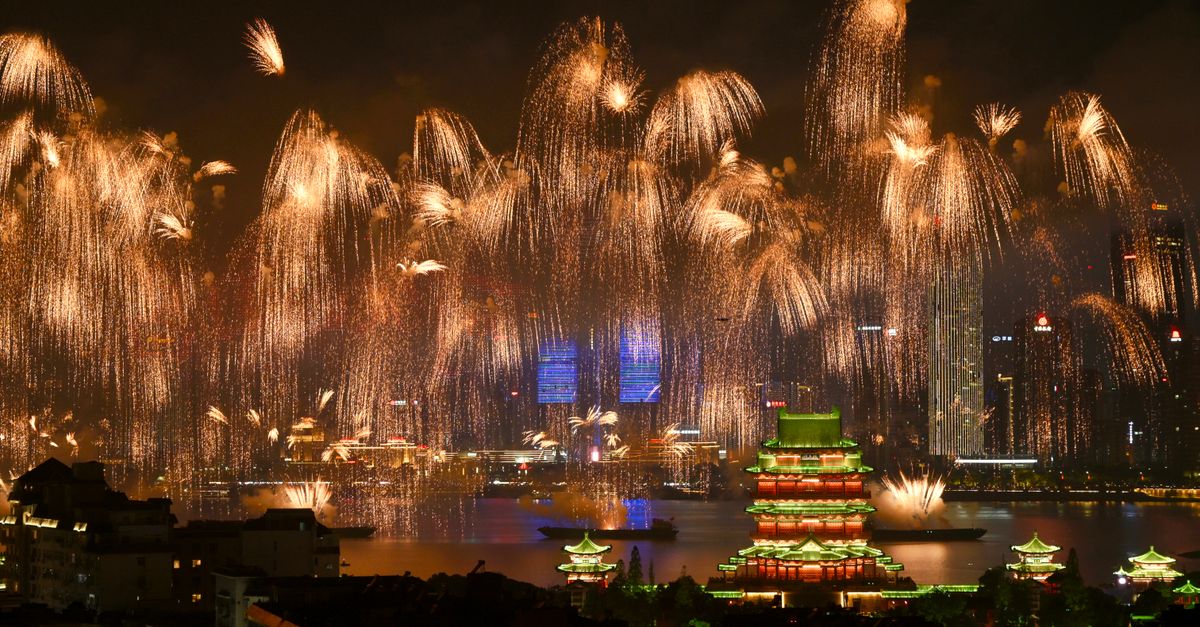
The willow is a slower, more elegant gesture. Its stars burn with a long, drooping trail, often gold, that hangs in the air and gently drifts downward like the boughs of a willow tree. Because the trails linger, willow effects produce some of the most enduring and emotional visual moments in a finale, and they are a favorite for slow, contemplative segments of a show.
4. Palm
A palm effect sends out a central burst whose thick, bright trails rise and then arc over before falling, mimicking the fronds of a palm tree. The trails are heavier and more pronounced than those of a willow, and palms frequently appear in large shows where their dramatic, canopy-like silhouette can fill a wide section of sky.
5. Crossette
The crossette (from the French for “little cross”) is one of the most recognizable and technically demanding effects. A large star shoots out and then, at the apex of its flight, splits into several smaller stars that form a cross or “X” pattern. Building a reliable crossette requires the star itself to be carefully engineered to break at a precise point, making well-executed crossettes a mark of craftsmanship.
6. Ring (and Saturn Ring)
A ring effect produces a perfect circle of stars, most often in a single bold color. The related Saturn ring adds a sphere of color (the “planet”) inside the encircling ring, creating a striking, jewel-like composition. Rings require extremely precise star packing to keep the circle unbroken, so a crisp ring is a sign of a premium shell.
7. Hummer (and Whistle)
The hummer is an auditory effect as much as a visual one: a shell launches small tubes that spin and emit a buzzing or humming sound as they fly. Closely related are whistles, which produce a piercing, ascending shriek. These effects add a sonic punctuation that cuts through the sky and are especially popular in consumer products and mid-show accents. If you have ever wondered how fireworks make those atmospheric whistling and crackling sounds, it is these spinning, vibrating compositions at work.
8. Strobe
A strobe effect produces a rapid, flickering pulse of light rather than a steady glow—often described as a “twinkle.” Strobes can be layered into other effects or used alone to create shimmering curtains of light. Because the flashing is engineered through the star’s burn rate, strobe intensity and tempo can be tuned to suit the mood, from a gentle glitter to a frenetic pulse.
9. Spider (and Kamuro)
The spider explodes in a burst of fast, thick, crackling trails that shoot outward in all directions, resembling the spreading legs of a spider—an effect packed with energy. The kamuro is its softer cousin: a dense sphere of uniform, slowly brightening gold stars that gradually drip downward, creating a shimmering, glittering orb. Kamuros are frequently used to close a segment with a sense of quiet grandeur.
10. Fish and Dragon Eggs
The fish effect launches dozens of small, darting points of light that arc outward and then scatter, evoking a school of fish suddenly startled into motion. Dragon eggs add a delayed, crackling burst after the initial explosion—hundreds of tiny “pops” that sizzle outward in a final flourish. Both are high-energy effects that read as playful and are excellent for punctuating a fast-paced section.
How Effects Are Engineered: The Chemistry and Construction Behind the Show
None of these effects happen by accident. Each is the product of deliberate choices in three areas: the chemical composition of the star (which determines color and burn characteristics), the physical shape and size of the star (which determines whether it trails, splits, or flickers), and the packing arrangement inside the shell (which determines the overall pattern). A peony and a chrysanthemum, for example, may use nearly identical color compositions—the only difference being whether the star has been formulated and shaped to leave a visible trail as it burns.
This is the same underlying science covered in our guide to how fireworks get their colors, where the role of specific metal salts—strontium for red, barium for green, copper for blue—explains why certain effects glow the way they do. Layering effects into a coherent show is itself an art form, and professional designers think about effects the way a composer thinks about instruments: building tension, contrast, and release across a performance.
Choosing Consumer Fireworks by Effect
You do not need to stage a professional display to enjoy these effects—most of them are available in consumer products, especially in multi-shot cakes, which pack dozens of pre-fused tubes into a single device that fires effect after effect in a choreographed sequence. When you read a cake’s label, you will often see the effects it produces listed by name: “peony and willow,” “crossette to red ring,” or “strobe with dragon eggs.” Knowing the vocabulary lets you shop with intention rather than guessing at random.
Whether a cake is sized at 200-grams or 500-grams significantly shapes both the effect’s size and the show’s duration, which is why our comparison of 200g and 500g fireworks cakes pairs naturally with this guide. If you are new to the hobby, start with a mix of a few reliable effects—say, a peony-heavy cake, a willow finale, and a strobe accent—before investing in the more rarefied crossettes and palms. And before you light anything, brush up on our essential fireworks safety tips, because no effect is worth an injury.
From Classic Effects to Modern Innovation
The classic vocabulary of effects has remained remarkably stable for over a century, and that continuity is part of what makes fireworks feel timeless. But the craft is not static. Manufacturers are continually refining star chemistry to produce deeper blues, longer burn times, and more reliable crossettes, while the rise of drone light shows has sparked a new conversation about what “effects” even means in a hybrid, technology-driven sky. You can see how these threads are converging in our coverage of drone light shows versus traditional fireworks.
At the heart of it all remains the same engineering discipline—the careful control of chemistry and geometry—that has powered every display for generations. Learn to read the effects, and you learn to read the whole sky. For a deeper look at where that craft comes from, start with how fireworks are made, and continue through our complete beginner’s guide to the types of fireworks.
Companies like Skysong Fireworks, based in Liuyang, China and operating since 2005 with both CE and DOT certifications, build entire product catalogs around the mastery of these effects—proof that even in today’s technology-driven market, the timeless language of peonies, willows, and crossettes still anchors the industry.